
ENTERPRISE SOFTWARE / NETWORK ACCESS CONTROL

WESERGATE · NETWORK ACCESS CONTROL 0.14.3

Understand every network access decision.

WeserGate brings devices, ports, identities, network events and policies into one explainable workspace. A developing network access control and operations platform. Observed facts stay separate from inferences, simulation from verified enforcement.

30-day evaluationDocker / on-premisesPRE-PRODUCTION / PILOT
NETWORK / POLICY / EVIDENCEv0.14.3
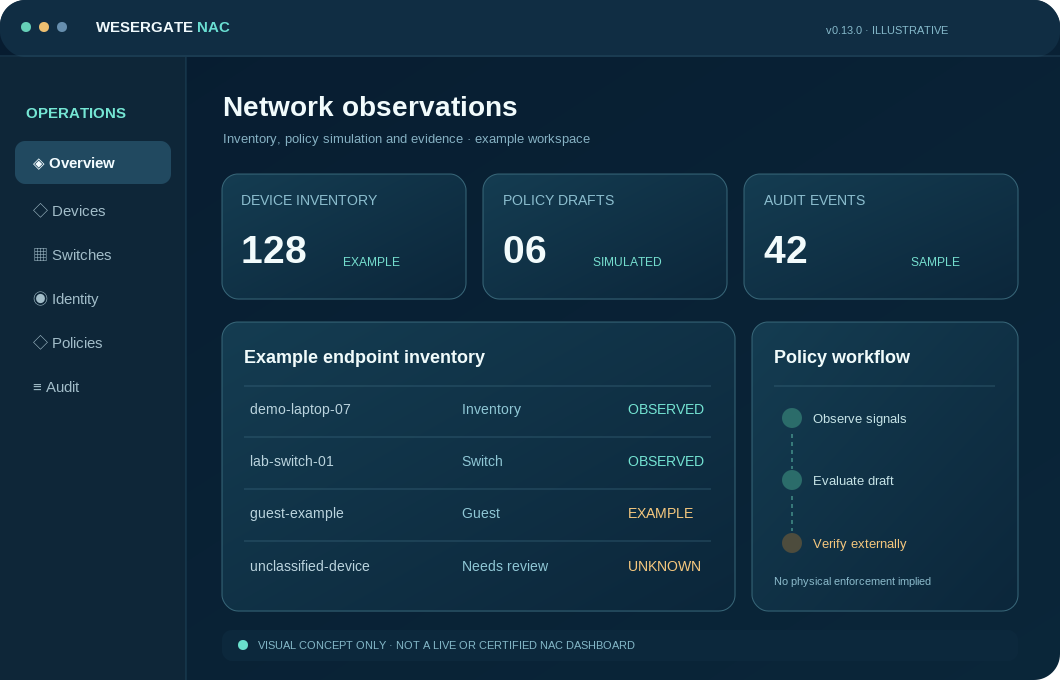
Illustrative WeserGate network operations interface showing inventory, policy simulation and audit evidence
ILLUSTRATIVE PRODUCT VIEW
NETWORK SWITCH · PORT · DEVICE
POLICY SIMULATE · REVIEW · AUDIT
109Documentation · Original product source · v0.14.3
140API reference
06One platform. Six workspaces.
v0.14.3PRE-PRODUCTION / PILOT
01 / Overview

Make network access decisions understandable.

Devices, switch ports, identities and policies belong in a traceable operational picture. WeserGate joins the signals while separating what was observed, inferred and actually enforced.

Device inventorySwitch / SNMPIdentity contextPolicy simulation
Product overviewOriginal product source · v0.14.3 · EN

What WeserGate does

A NAC system should answer four questions: Which device? Which person? Which location? Which authorization rule? WeserGate v0.12 provides records and evidence for many of these questions and a framework for policy decisions. It is designed to keep administration separate from network authorization traffic.

Architecture

The one-container appliance supervises PostgreSQL, FastAPI, a background worker, HTTPS proxy and optionally a reject-all RADIUS preflight service. Persistent application data, secrets and certificates live in a Docker volume. The pre-production Linux host can use a management NIC and a restricted quarantine NIC; the host network and firewall are managed by Linux, not silently by the web container.

The three-stage model

  1. Discover: read-only switch observations, approved private-range scan candidates and identity events.
  2. Correlate: associate MAC, port, switch, session, category and ownership evidence with provenance.
  3. Review / act: propose or simulate policy actions. Hardware changes are behind explicit operator controls and must be independently verified.

Audience

Network administrators, security operators, IT helpdesk users and pilot-lab engineers. Designed for controlled evaluations with ArubaOS-Switch equipment and existing enterprise identity infrastructure.

Explicit limitations

This is not a replacement for a proven production NAC on day one. A built-in listener that responds to status tests and rejects all Access-Requests is not an EAP authentication system. In external-direct RADIUS mode, the external server remains the authority for its own decisions. Verified 802.1X, RADIUS accounting and switch VLAN movement require site acceptance testing.
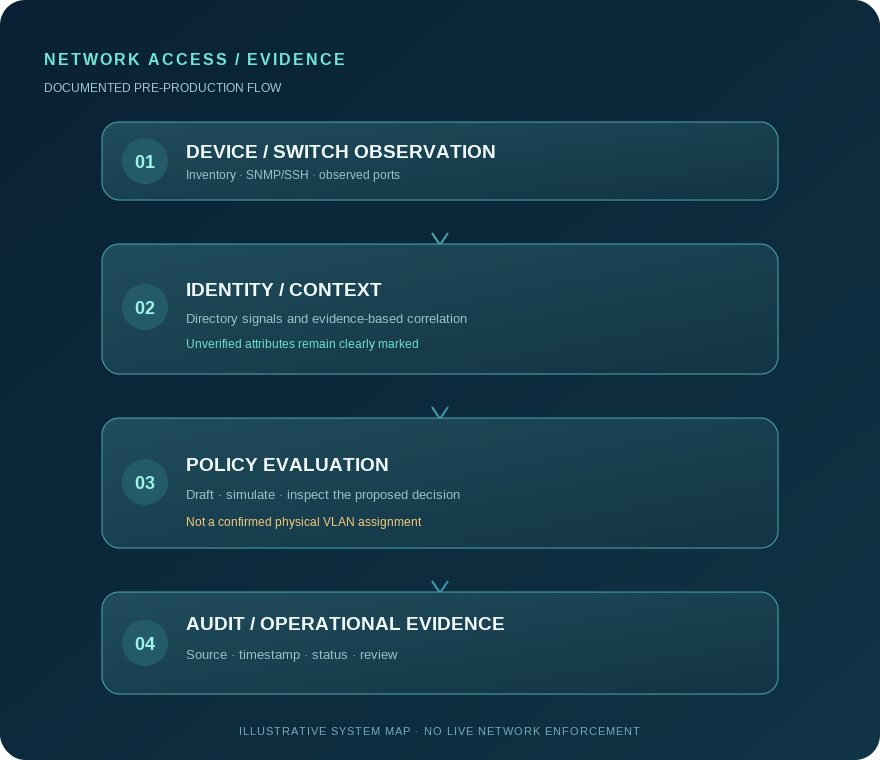
Illustrative four-stage flow from device discovery and identity context to policy simulation and audit evidence
ILLUSTRATIVE PRODUCT VIEW
02 / Capabilities

Six workspaces. One coherent view.

A developing network access control and operations platform. Observed facts stay separate from inferences, simulation from verified enforcement.

01

Devices & inventory

Endpoints, categories, groups and traceable discovery.

TECHNICAL DETAILS
02

Switches & ports

SNMP/SSH connections, controlled discovery and port visibility.

TECHNICAL DETAILS
03

Identity & integrations

AD/LDAPS, Keycloak, SMTP and RADIUS test paths.

TECHNICAL DETAILS
04

Policies & simulation

Policy drafts, evaluation and guarded network operations.

TECHNICAL DETAILS
06

Operations & licensing

Docker profiles, monitoring, backup and signed offline licenses.

TECHNICAL DETAILS
Original product source · v0.14.3 · Features and maturity matrix
Area What exists Verification boundary
Dashboard Saved widgets, auto-refresh, gauges, charts Real data only, availability depends on collection
Devices Manual records, evidence, classification, owner provenance MAC/OUI does not prove user identity
Users Local inventory, AD-origin verification and access lists AD login of a Windows session is not universally detected
Groups Manual/automatic matching, linked access rules Group rules alone never grant network authorization
Switches SNMPv3, SNMPv2c, SSH adapter and port observations Aruba firmware-specific testing required
Discovery Three-stage pipeline, IP scan with approval IP scan does not assert MAC or authorization
RADIUS External settings/tests, REST adapters, reject-only preflight No turnkey live EAP/RADIUS server or working proxy
Identity AD LDAPS lookup and Keycloak PKCE test Production directory and OIDC systems required
Policies Prioritized rules, simulations, drafts and default deny Simulation is not switch enforcement
Quarantine Policy intent, guarded CoA adapter No demonstrated initial switch isolation
Guests Sponsor, approval, expiration and revocation records Full redirect and captive onboarding not validated
Security Argon2, MFA, RBAC, encrypted secrets, audit chain Third-party penetration test not completed
Deployment One-container Docker, preproduction host NIC wizard Not high-availability or production certified
Licensing 30-day persisted trial, signed commercial licenses Offline anti-tamper limitations; no payment gateway

This matrix should be published with a version label and updated when tests on actual hardware complete.

03 / Architecture

From network signal to reviewable evidence.

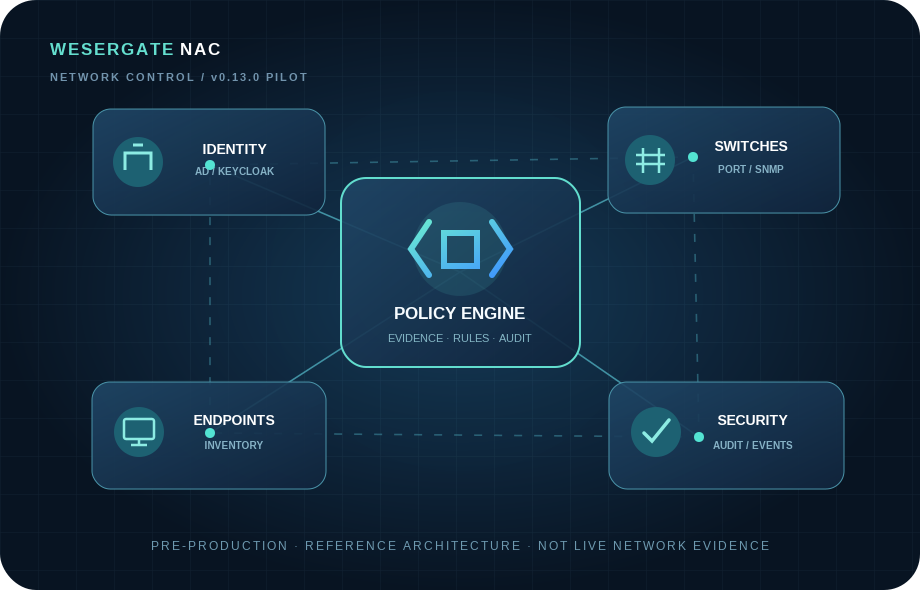
The documented architecture separates discovery, identity context, policy simulation and audit. Physical network enforcement remains subject to acceptance on actual hardware.

Illustrative WeserGate topology connecting identities, switches, endpoints and policy engine
Architecture and trust boundariesOriginal product source · v0.14.3 · EN

Components

The single appliance runs API, worker, database, HTTPS proxy and controlled auxiliary processes. /api is the management interface; /api/internal/radius is a service interface and must not be publicly reachable. The onboarding-facing listener must reject admin APIs.

Trust boundaries

  • Browser administration: session cookie + CSRF token, permission checks and audit records.
  • Switch collection: management network, transport-specific credentials, bounded discovery and evidence timestamps.
  • RADIUS service: service token; RADIUS messages and EAP have their own protocol security requirements.
  • Identity: LDAPS and OIDC with TLS; Keycloak user login does not authorize a switch by itself.
  • Linux host: NIC addresses and network routing are privileged operations. They require local-console activation with rollback.
  • Licensing: customer image contains only the vendor public verification key; the private license signing key remains with the seller.

Availability limitations

A single container is convenient for a pilot, but it is a single point of failure. Do not deploy as the sole authentication authority until tested failover, backups, monitoring, firewall controls, EAP and switch acceptance exist.

04 / Security

Control requires defensible boundaries.

Roles, identity integration, audit and network safeguards work together. Preflight is intentionally constrained; simulation is not proof of a real VLAN change.

Pre-production · v0.14.3

Not a certified production NAC. Physical switch/RADIUS enforcement and 1,000-device traffic remain unverified.

Security preflight and restrictionsOriginal product source · v0.14.3 · EN
  • Restrict management HTTPS to trusted administrator networks and use a valid CA-issued certificate.
  • Physically or out-of-band verify both Linux NIC IPs and routing.
  • Use SNMPv3 with authentication/privacy where available; pin SSH host keys; avoid SNMPv2c outside a deliberately isolated lab.
  • Store shared secrets through encrypted integration settings, not source files.
  • Keep database, Docker socket, license private signing key and temporary setup link inaccessible from guest networks.
  • Enable administrator MFA, retain role separation and audit logs, and test backup restoration.
  • Confirm real Aruba firmware capabilities, test port isolation before attaching a user, and record switch rollback commands.
  • Keep NTP accurate for certificate validation and trial/paid license dates.
  • Confirm the onboarding listener cannot access administrative API routes.

Stop conditions: guest reaches management, invalid TLS bypass is required, unknown device gets unrestricted network access, switch reports inconsistent VLAN, or the system cannot recover after a service outage. Do not proceed to real enforcement under these conditions.

05 / Walkthrough

Follow a decision from first observation to evidence.

Explore four interactive steps with static example data. No network operations are performed.

INTERACTIVE PRODUCT WALKTHROUGHILLUSTRATIVE DEMO · NO LIVE CONNECTION
01 / 04

Observe facts before making assumptions.

Inventory and switch observations are distinct from automatically verified device properties.

WeserGate NAC · v0.14.3SIMULATION
Devicedemo-laptop-07
SourceInventory / switch observation
Portsw-lab-01 · GigabitEthernet 1/0/7
Static example data. No live network discovery, RADIUS authentication, or switch enforcement.
07 / Request a quote

Discuss your pilot scope and acceptance plan.

Define the target network, integration prerequisites and real-hardware acceptance tests before production use.

Request a quote
WeserGate NAC | Network Access ControlOriginal product source · v0.14.3 · EN

WeserGate NAC is a developing network access control and network operations platform from WeserCode. It combines device inventory, switch discovery, identity integrations, policy simulation, administration and security audit workflows into one container-based appliance.

Know your network. Understand every access decision.

Manage known endpoints and users, correlate evidence from network switches, build policy drafts and inspect authentication sessions. WeserGate keeps observed facts separate from inferred device characteristics and distinguishes an authorized decision from a switch-verified VLAN change.

What is available in v0.13?

  • Custom dashboard with configurable widgets, charts and refresh intervals.
  • Asset, user, group, category and switch/port inventories.
  • Manual registration and background SNMP/SSH discovery adapters; bounded, reviewed IP scans.
  • RADIUS topology configuration, policy simulator, accounting bridge endpoints and a reject-only built-in FreeRADIUS preflight listener.
  • AD LDAPS lookup, Keycloak OIDC test flow, SMTP connectivity tests and setup wizard.
  • Admin sessions, RBAC, MFA, audit integrity and guarded network-change operations.
  • 30-day trial and hybrid signed one-/three-year endpoint-capacity licensing activation.

Availability note: v0.12 is a pre-production pilot build. EAP-TLS/PEAP authentication, captive-network redirects, verified live Aruba VLAN assignment, HA and full commercial certification are not delivered as turnkey production capabilities. Never advertise this build as a certified production NAC.

Explore documentation · Trial & licensing · Contact WeserCode

Future customer portal (not live): quote requests, offline license downloads, invoices, updates and support are documented in the portal implementation handoff, not yet accessible as a working account service.

WeserGate v0.14.3 is pre-production; technical and commercial approvals are pending. Visuals are illustrations, not live NAC screens. WeserCode customer accounts and support requests are available. Automated payment and signed license issuance remain unconnected. v0.14.3 documentation draft: technical, legal and commercial reviews are still pending.