
What WeserGate does
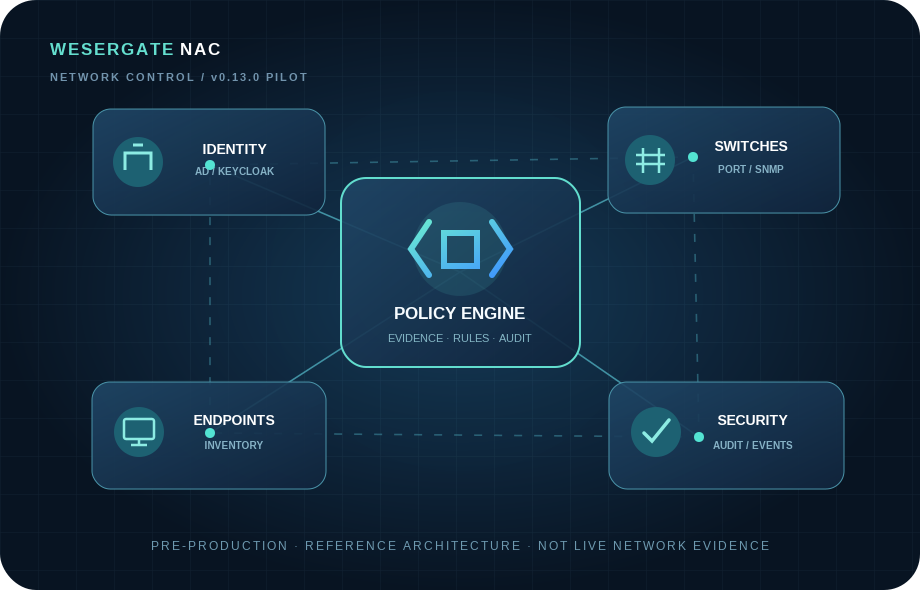
A NAC system should answer four questions: Which device? Which person? Which location? Which authorization rule? WeserGate v0.12 provides records and evidence for many of these questions and a framework for policy decisions. It is designed to keep administration separate from network authorization traffic.
Architecture
The one-container appliance supervises PostgreSQL, FastAPI, a background worker, HTTPS proxy and optionally a reject-all RADIUS preflight service. Persistent application data, secrets and certificates live in a Docker volume. The pre-production Linux host can use a management NIC and a restricted quarantine NIC; the host network and firewall are managed by Linux, not silently by the web container.
The three-stage model
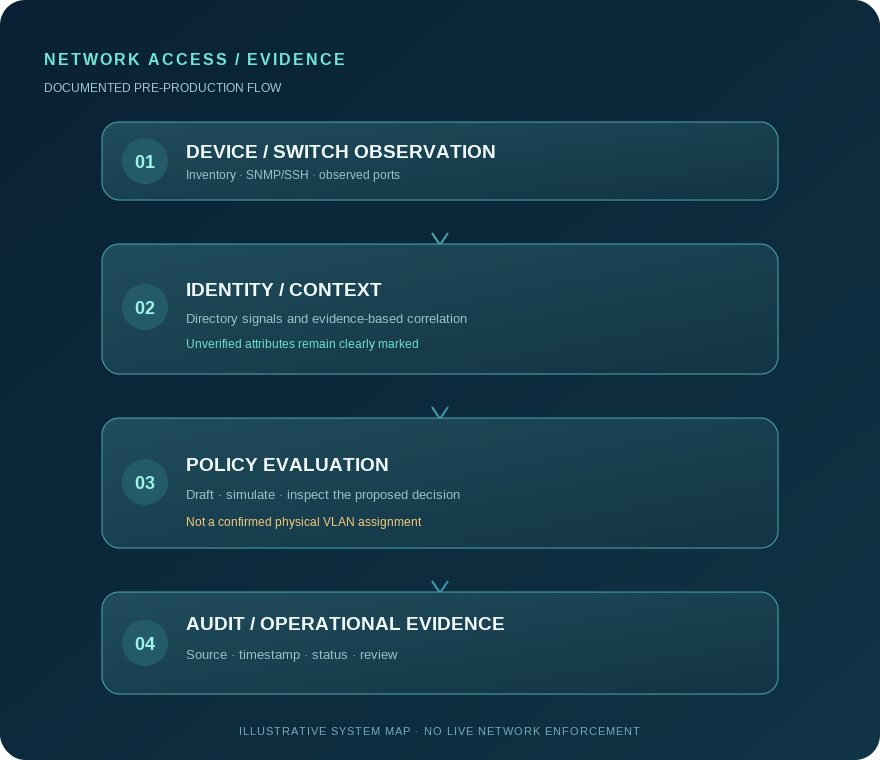
- Discover: read-only switch observations, approved private-range scan candidates and identity events.
- Correlate: associate MAC, port, switch, session, category and ownership evidence with provenance.
- Review / act: propose or simulate policy actions. Hardware changes are behind explicit operator controls and must be independently verified.
Audience
Network administrators, security operators, IT helpdesk users and pilot-lab engineers. Designed for controlled evaluations with ArubaOS-Switch equipment and existing enterprise identity infrastructure.
Explicit limitations
This is not a replacement for a proven production NAC on day one. A built-in listener that responds to status tests and rejects all Access-Requests is not an EAP authentication system. In external-direct RADIUS mode, the external server remains the authority for its own decisions. Verified 802.1X, RADIUS accounting and switch VLAN movement require site acceptance testing.